Color block — the deliberate pairing of two or three saturated colours in a single outfit — is one of fashion's most reliable trends. Done well, it transforms simple silhouettes into modernist statements. Jewellery is the most precise tool for tying a colour-blocked outfit together, or for tipping it over the edge into chaos. Here is how to use jewellery as the colour-block referee.
What color blocking actually meansColor blocking is the wearing of large, defined blocks of solid colour next to each other — typically 2–3 distinct colours per outfit, with each one occupying a substantial area. The contrast is the point.
The technique entered fashion mainstream through Yves Saint Laurent's 1965 Mondrian collection, which translated Piet Mondrian's painting grids directly to dresses. It has returned in waves ever since — particularly strongly in 2010, 2018 and 2024.
The four principles- Pick a colour wheel relationship. Complementary (opposite on the wheel — orange + blue), analogous (adjacent — yellow + orange + red), or triadic (three equally spaced — red + yellow + blue).
- Limit to 2–3 colours. Beyond that the look reads cluttered.
- Vary the proportion. A 70/20/10 split (one dominant, one secondary, one accent) is more sophisticated than equal thirds.
- One colour anchors the silhouette. The biggest block (usually the bottom or the dress) sets the tone.
In a color-blocked outfit, jewellery does one of three jobs:
- Tie the colours together by introducing a metal that complements all of them.
- Add the third "accent" colour when the outfit only has two.
- Stay quiet when the outfit is already busy.
Choose your role first; the specific piece follows.
Choosing the metalMetal is the most powerful tie-together tool:
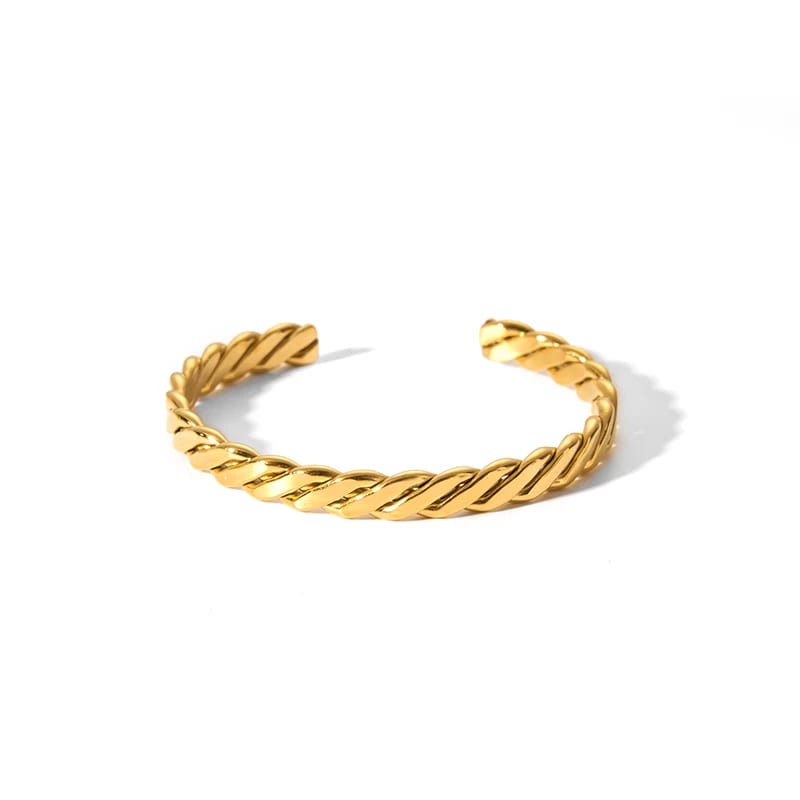
- Yellow gold warms cool palettes (blue + white, blue + green) and harmonises with warm palettes (red + orange, yellow + pink). Universal.
- Rose gold pairs especially well with red, pink, peach, coral.
- White gold / platinum / silver reads modernist and architectural; complements bold blue, navy, black-and-white, blue-green palettes.
- Mixed metals — a gold + silver bracelet stack — works when the outfit's colours pull from both warm and cool palettes.
If your outfit has two strong colours, jewellery can introduce the third — much less commitment than buying a third clothing item:
- Cobalt blue dress + white blazer: add coral or rose-gold pieces for a triadic warm accent.
- Yellow blouse + navy trousers: add red or burgundy via a garnet pendant or ruby earrings.
- Emerald green skirt + cream top: add pink jewellery (morganite, rose quartz) for a complementary contrast.
- Black + white outfit: any colour works as the accent — let the jewellery be the entire colour story.
Blue + orange (complementary)
- Navy or cobalt sweater with rust trousers.
- Jewellery: yellow gold to bridge; pearl earrings to soften; or coral as a deeper accent.
Yellow + violet (complementary)
- Mustard skirt with deep purple top.
- Jewellery: amethyst studs (echo the violet), yellow gold bracelet (echo the yellow), pearls keep it luxurious.
Red + green (complementary)
- Emerald blazer with a deep red blouse.
- Jewellery: yellow gold dominates; small pearl studs neutralise; avoid additional colour.
Pink + green (analogous to blue + orange but softer)
- Soft pink skirt with sage green top.
- Jewellery: rose gold + pearl. Avoid additional colour — the outfit is already balanced.
Black + white + one bold colour (high contrast)
- Black trousers + white blouse + scarlet handbag.
- Jewellery: rich gold or silver. Add a single colour-matching ruby or red coral if you want to echo the bold accent.
- Bold colour blocks call for clean, sculptural jewellery — big enough to be seen, simple enough not to clutter.
- Avoid small fussy pieces in color-blocked outfits — they get visually lost.
- Single statement piece beats many small ones.
- Match the scale of the colour blocks — bigger blocks call for slightly larger jewellery.
- Patterns within color blocks — prints make it impossible for jewellery to land.
- Five colours. If your outfit already has 4–5 colours, additional colour from jewellery becomes noise.
- Matching jewellery exactly to the dress colour. A red ruby pendant on a red dress disappears; on a black-and-red dress it sings.
- Overly busy gemstone clusters — color block likes clean stone shapes.
- Mixing metals at the same time as mixing strong colours — pick one source of complexity.
Modern minimalist
Cobalt blue silk shirt, ivory wide-leg trousers, gold knotted hoops, a single thin gold chain, gold watch.
Romantic
Sage green wrap dress with blush pink heels and a champagne clutch. Rose gold pendant with a small pearl drop, pearl studs, no bracelet.
Architectural
Deep yellow midi skirt with a black turtleneck. Sterling silver sculptural cuff, large silver hoops, no necklace.
FAQCan I wear color blocking to work?
Absolutely — keep the colours muted (navy + camel + cream) and the jewellery understated for office settings, or brighter (cobalt + ivory + gold) for creative workplaces.
What about pattern + color block together?
Choose: either color blocking or pattern, not both. Color blocking depends on the visual quietness of the colour fields.
Is color block flattering on every body?
Yes, with attention to placement. Darker colours visually recede; lighter colours advance. Place darker blocks where you want to slim; lighter where you want to highlight.
For seasonal palettes, see our summer colorimetry guide or your colour palette guide.